


Hassan Akkad: Between the Camera, Damascus and the Courage to Ask Questions

By: Leen Shoura
An interview for From Syria, With Love

It is August in Damascus, and the heat is relentless.
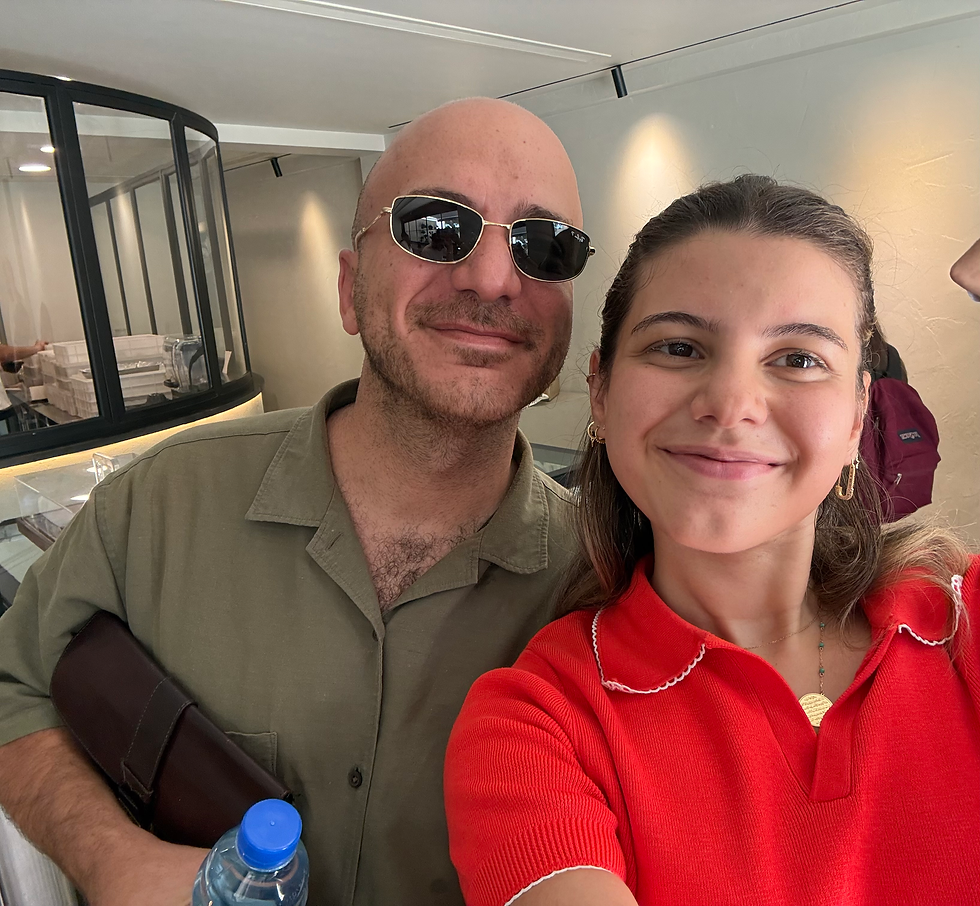
Hassan Akkad is sitting at Nash bakery with a Spanish latte in front of him. Outside is the city he has left, returned to, filmed, defended, criticised and continued to call home through several different versions of himself.
Teacher. Filmmaker. Refugee. NHS worker. Artist. Activist.
Ask Hassan which of those identities describes him today, however, and he reaches for different words. Cultural saboteur, he offers. Then, more simply:
Satirist.
At 38, Hassan says he feels as though he has already lived several lives. Yet listening to him speak, those lives do not seem separate. The teacher who once stood in front of classrooms in Syria, the filmmaker who documented his journey to Europe, the refugee rebuilding his life in Britain, and the campaigner now asking uncomfortable questions in Damascus all seem to have converged into the person sitting here today.
This is not simply an interview about what happened to Hassan Akkad.
It is about who those experiences made him become.
If someone knew nothing about you, not the films, the journey, the campaigns, who is Hassan Akkad today?
Hassan: My name is Hassan Akkad. I'm Syrian-British. I'm an artist and a filmmaker, and recently I've discovered another label that I think describes me quite well: I'm a cultural saboteur.
I like making art that inspires people, but also makes them think outside the box. I like using elements that aren't very conventional. I like defying expectations.
Outside all of that, I love driving. I don't have one particular niche in music; I listen to almost everything. I'm a cinephile, I watch films all the time. And, strangely enough, I taught myself how to give massages about two years ago.
So there are lots of different sides to me.
But if you're asking what feels closest to who I am right now, I would probably say I'm a satirist.
I'm 38, and I've had a few lives.
I loved teaching when I was in Syria because I genuinely felt I was doing something with a positive impact. Building and rebuilding a society starts in the classroom. There's a saying that when you teach, you learn twice. I taught for five years, and I learned so much from my students. I saw myself in them. Teaching also taught me something about leadership, because when you're leading a classroom, you're leading a group of people.
Being a refugee was different. That was a temporary identity that lasted around seven years. By 2015, particularly around the Russian intervention, I had begun to accept that I might not be able to return to Syria. I needed another home. And having another home meant putting down roots and eventually having citizenship somewhere.
Working for the NHS was another chapter. During COVID, lockdown was extremely difficult for me. I don't cope well with being told to stay indoors, partly because I'm claustrophobic. I wanted to help, but if I'm completely honest, I was also trying to help myself. A frontline job meant I could leave the house and have something resembling a normal life.
What I'm doing now feels like all of those people coming together.
I'm calling on the teacher in me, the filmmaker, the artist, the frontline worker who wants to help people, the satirist, and even the prankster I was as a teenager.
I've put all of those people into one character.
That's probably who I am today.
You describe yourself as an "outlier." Did that feeling of living between identities begin before you ever left Syria?
Hassan: Absolutely.
Even as a teenager, I had issues with identity. I'm Syrian, born to Syrian parents, but I was heavily influenced by American pop culture.
There was a period when I wanted to be like, No, I'm American. I listen to Eminem. I'm cool. I don't speak Arabic.
Obviously, that was an immature version of me trying to belong somewhere else.
Then I actually left Syria.
I moved to England in 2015, and suddenly I found myself yearning for that kid who could simply say, No, I'm Syrian
That's why I use the word outlier. Outliers don't necessarily belong to one particular place; they exist somewhere around the margins.
But now I actually feel fortunate.
I have two places I can call home.
Syria will forever be home, but England is my adopted home. In many ways England adopted me, and living there shaped my personality. I've also been privileged enough to live in several places, and that expanded my horizons and changed the way I see the world.
I used to say, "My roots are in Damascus."
Now I like to think I have roots everywhere.
When you close your eyes and think of Damascus, what comes back first?
Hassan: Car horns.
Sadly.
Everyone is honking. Syrians are very impatient, for understandable reasons, so I associate Damascus with that sound.
And the smell is probably street food married with car fumes. That's how a lot of the streets of Damascus smell to me.
But it depends where you are. Near where I live there's a vegetable market, so you smell all the produce. Tomatoes in Syria actually smell like tomatoes. They smell completely different from the tomatoes you buy abroad.
Damascus has all these little sensory memories attached to it.
Even the places that smell terrible become part of your memory of home.
If you could send a package from Syria, with love, to the rest of the world, what would be inside?
Hassan: Backgammon sets.
Definitely backgammon sets.
I'd send resilience too. Syrians have become masters of resilience. I don't believe in creating a hierarchy of trauma, and I don't like saying, "Look at everything we've been through," but Syrians have proved, to the world and to themselves, that they can be incredibly resilient.
I'd send olive oil. Syrian furniture. Mosaic, even though it's not always very practical.
But most importantly, I'd send art.
Syrians have produced incredible art. Syrian drama has this extraordinary history. The music, cinema and wider art scene continue to exist despite everything the country has experienced and despite the economic situation.
And I'd send za'atar.
Our za'atar is better than Jordanian za'atar.
That might start another war, but I'll say it anyway.
Before the world knew you as a refugee, you were a teacher and filmmaker with a life in Syria. Why was it important to you to film the journey to Europe yourself?
Hassan: There were two main reasons.
I made the journey in 2015, at the height of what was being called the refugee crisis in Europe. I was watching these stories being told, but they were almost always being told from a third-person perspective.
Other people were telling our stories.
That sits at the heart of one of my biggest problems with storytelling: a lack of agency.
I wanted to document the journey the way I wanted to document it.
The second reason was personal. I knew I was going through a milestone in my life. This was a life-changing event, and I wanted a record of it.
But the camera also became something else.
It became a shield.
My mental health was in tatters. The journey was incredibly dehumanising. You're treated like a number. You're travelling in overcrowded dinghies, in the backs of lorries, dealing with smugglers.
And only a couple of years earlier, I had been teaching. I had my career. I was around my family. I felt like I was smashing it in life.
Then suddenly you're a package.
By putting the camera between myself and what was happening, I could almost protect myself from the reality of it. I could stand behind the camera and point it at the experience rather than allowing the experience to completely consume me.
I didn't know at the time what that footage would eventually become.
Later I met filmmakers working on the BBC series Exodus: Our Journey to Europe, and we ended up making that series together.
But when I originally started filming, I was trying to retain agency over my own story and, in some ways, survive it.
You often criticise the way displaced people are reduced to their worst experiences. What do you think gets lost when we tell stories only through suffering?
Hassan: Their humanity.
I talk a lot about what I call trauma porn.
Syrians and Iraqis before them, Palestinians, Sudanese and many other communities that have experienced war and displacement and still are, often find themselves reduced to their trauma.
The questions become: What happened to you? Tell us about the torture. Tell us about the journey. Tell us about the worst thing.
Because tragedy creates attention.
And again, the problem is agency. Other people are often telling these stories.
I think the solution is giving people the tools to tell their own stories, because then they decide how vulnerable they want to be. Maybe I want to talk about something terrible that happened to me. Maybe I only want to hint at it. Maybe I don't want it to define the story at all.
People need to be three-dimensional.
When displaced people receive attention, they're so often expected to be either victims or superheroes. You're either the poor broken person people want to rescue, or you've done something extraordinary and suddenly you've "earned" recognition.
Why?
Why can't somebody simply be a person?
When I talk about my own journey, I don't only want to tell you about the terrible moments. I want to tell you about the jokes we made. The music we listened to. I once met a woman in northern France and we had a little thing while I was travelling. That matters too.
Because I was still human.
When I've interviewed displaced people, I've sometimes started with their Spotify playlist.
What music do you listen to? What's your favourite film? Who were you before the event that changed your life?
That person matters.
Is that also what you think is missing from the international story of Syria?
Hassan: Generally, yes.
When does Syria appear in the international press?
A bombing. A massacre. A tragedy.
Those are obviously incredibly important things for journalists to cover. But Syria becomes breaking news.
I don't want Syrians to exist only as breaking news.
I want long reads about Syria. I want in-depth stories about Syrian culture, subcultures, history and communities.
The social fabric of Syria has been badly damaged. But despite that, there are beautiful things happening: civil-society initiatives, people cleaning streets, workshops, people repairing things in their neighbourhoods, cycling groups, running clubs, dance classes.
There's a whole tapestry of ordinary life.
That's what I'd like people outside Syria to see more of.
Syria is also incredibly diverse. Damascus is not Deir ez-Zor. Homs isn't the coast. The south isn't Idlib. You cannot visit Damascus for four days, eat ice cream in the Old City, take some photographs and say, "Okay, I've seen Syria."
You haven't.
I want more human stories coming out of Syria, not only breaking news.
After years away, you've chosen to spend more of your life in Syria again. What does rebuilding mean to you when the physical destruction is only one part of what was broken?
Hassan: Rebuilding means almost everything.
Of course I want the streets to look better. I want the Old City to receive love and attention. I want visitors to come here and see something beautiful.
But we can't care about the façade and ignore what's happening inside.
For me, two priorities stand out.
The first is transitional justice.
There is no peace without justice.
If somebody who harmed you is walking around without being held accountable, how are you supposed to heal? Syria has enormous collective trauma. Healing requires closure, and closure requires justice.
The second is education.
I keep coming back to this because I was a teacher: rebuilding society starts in the classroom.
Schools are overcrowded. Teachers have struggled with extremely low pay. Universities have their own problems.
Anyone dealing with the next generation has to understand that this generation is our greatest currency.
The people coming through our schools and universities today are the people who will be running this country in twenty or thirty years.
That's why education has to be a priority.
And for Syrians who built lives abroad, as you did, what does returning or contributing responsibly look like?
Hassan: There are so many ways to contribute, and it doesn't always have to look like charity.
Social entrepreneurship is one.
Invest.
Start a business. If you employ twenty or thirty people, that's potentially twenty or thirty families with an income.
Part of the reason I want Syria to become more of my base is that I'd rather eventually be contributing economically here too.
I spent years working in England, paying taxes and contributing there. England gave me a home and gave me a lot.
Now I also want Syria to benefit from whatever skills and knowledge I've gained.
This is such a critical moment for the country. So many people paid an unimaginably heavy price for us to reach a point where you and I can sit in a café in Damascus and have this conversation.
People lost their homes, their businesses and their lives. People died trying to cross seas.
We can't waste that.
But helping Syria can sound so enormous that people become paralysed by it.
So don't ask yourself, "How do I help Syria?"
Ask yourself, "How do I help one corner of Syria?"
There's a park near where I live that children use. It needs work. Imagine somebody abroad putting a relatively modest amount of money into fixing that one park.
Suddenly hundreds of children have somewhere safer to play.
That's the ripple effect.
Find your corner.
Somewhere along the way, the teacher and filmmaker became a satirist, publicly asking where the money went. How did Hato El Flous ("Hand over the money") begin?
Hassan: I had been making a series called Reasons to Visit Syria. After Syria's political transition, I made a video around a fundraiser, and I started watching these fundraising campaigns happening across the country.
I was genuinely inspired.
You'd see millions being pledged and think, Wow. Syrians care. People want to rebuild this country.
And many people did pledge and pay. We should always be grateful to them.
But some people received all the attention for making enormous pledges and then didn't pay.
So my thinking was very simple:
If you received attention for pledging the money, it's only fair that you receive some attention for not paying it.
That's how it started.
Why turn accountability into satire?
Hassan: Because traditional advocacy can be boring.
Especially somewhere like Syria, where people have sympathy fatigue. People have seen so much.
If I sit in front of a camera and speak in this very traditional, serious advocacy language, people might switch off.
My number-one rule in storytelling is: defy expectations.
What do people expect an accountability campaign to look like?
Do the opposite.
And satire is already deeply Syrian.
We love satire. We have this history of using humour to talk about serious things.
So the idea became: inform people and entertain them at the same time.
That's how you hold attention.
The campaign almost became a reality show. People were laughing, but they were also learning. And crucially, there were calls to action.
There is frustration and anger in Syria. The question is how you channel it.
Instead of simply being angry, maybe you send an email. Maybe you ask a question. Maybe you comment. Maybe you participate.
People sometimes say that I "give a voice to the voiceless." I hate that phrase.
Everyone has a voice.
What people don't always have is a platform.
I happen to have one.
And communication, satire and storytelling are my bread and butter. These are my skills.
I'd feel like I was failing people if I didn't use them for something I believed mattered.
That campaign eventually led to something far more serious: your detention. Did that experience make you question whether continuing was worth it?
Hassan: Of course.
I've thought about stopping several times.
I have two elderly parents who constantly worry about me.
But then we receive support from Syrians from different parts of this incredibly complicated tapestry. We receive messages saying that people value what we're doing.
When you do this kind of work, the public becomes your boss.
You have to listen.
If you launch something and the overwhelming response from the public is that they hate it, maybe you need to reconsider your approach.
But if people are telling you that what you're doing matters, then you have a responsibility too.
You started something.
You can't simply walk away from it.
And despite everything, I still think about how extraordinary it is that this kind of work can happen in Syria at all.
I wouldn't have dreamt of doing this here before.
I think of it like rain.
Rainfall starts with individual drops.
We're one of those drops. We're certainly not the only ones; there are many people doing extraordinary work.
But eventually those drops can become rainfall.
That's what I'm looking for.
So when does Hato El Flous become successful? When the money is paid, or when people realise they can ask the question themselves?
Hassan: The second one.
We've already had tangible results. Money has been paid after questions were raised. There's been advocacy and attention.
But one of the moments that made me happiest was hearing from university students whose grades were being withheld.
They started their own campaign.
They saw what we were doing and thought, We can do this too.
And it worked.
That is impact.
The long-term goal shouldn't be for me to remain at the centre of everything.
The campaign should become something more structured. Maybe eventually it's an organisation or association. Maybe we move to other issues.
There are so many things that deserve attention.
What we've learned is that we now have tools, networks and experience. It would be a shame not to use them.
The purpose isn't to embarrass people.
It's to activate Syrian civil society.
The ability is already there. The frustration is already there. The education and talent are already there.
Sometimes people simply need to see that they can act.
After everything you've lived through, from a classroom in Syria, to filming yourself crossing Europe, to building another home in Britain and then returning to Damascus, what idea do you carry with you now?
Hassan: Active hope. Not passive hope.
Passive hope is sitting on the couch saying, "Hopefully everything will be okay."
Active hope is getting up and doing something to make it okay.
I want us to believe that Syria is going to be okay.
But saying "Syria is going to be fine" cannot just be words.
You have to go out and do something.
You have to get your hands dirty. That's active hope.
Teacher, filmmaker, refugee, NHS worker, satirist: Hassan has worn many titles, and he will likely collect a few more. But listening to him in Damascus, the thread running through all of them is clear. Every version of him has refused to stand still and wait. For Hassan, hope is not something you sit and wish for. It is something you do, one corner of Syria at a time.
Always remember: from Syria, with love
Comments